
Case study · AI platform
Humanbrand AI: one brand, three perceptions, measured
We built Brand OS for two US partner clients who are experts in branding consultancy. It is a perception-governance platform: it reads everything a brand has published, measures what people and AI systems have actually learned about it, and shows the gap with what the brand intends.

The challenge
Traditional branding is slow and costly, and it is outpaced by today’s market cycles. And a brand exists in three versions that rarely agree: what people have learned about it, what AI systems have learned about it, and what the brand intended.
Our clients, two US partners with deep branding-consultancy experience, wanted evidence instead of opinion: a system that governs what the market and AI have already learned about a brand, not just what it says next. Brand OS turns their methodology into software, from diagnosis to evidence-gated, launch-ready content.
Three perceptions, read in sequence
01 · Outside-in, evidence only
Human Perception
What the outside world has actually learned from everything the brand has published. Read with no guidelines and no internal context (the “Amnesia Protocol”).
02 · The MX Observatory
Machine Perception
How AI systems structurally encode the brand: what they retrieve, what they miss, what they invent. Measured as consensus across several models, not one model’s opinion.
03 · Enters last, by design
Intended Brand
Guidelines, strategy and positioning enter the system only after both outside-in views are complete.
What the platform does
Ingests the brand’s owned-channel corpus and reconstructs the brand platform that has actually emerged
Classifies narratives as Owned, Earned or Fragile, and finds those that are invisible
KARI (Knowledge Architecture for Real-time Intelligence): ask questions in plain language across six intelligence layers and get cited, confidence-scored answers
Proof states for every claim (Intended, Announced, Available, Proven) with an Evidence Value score: a system that can say no
A Content Action Model that turns the diagnosis into what to publish next, with dual-perception content scoring
Convergence tracking (converging, stable, diverging) and competitive signal monitoring
Inside the product
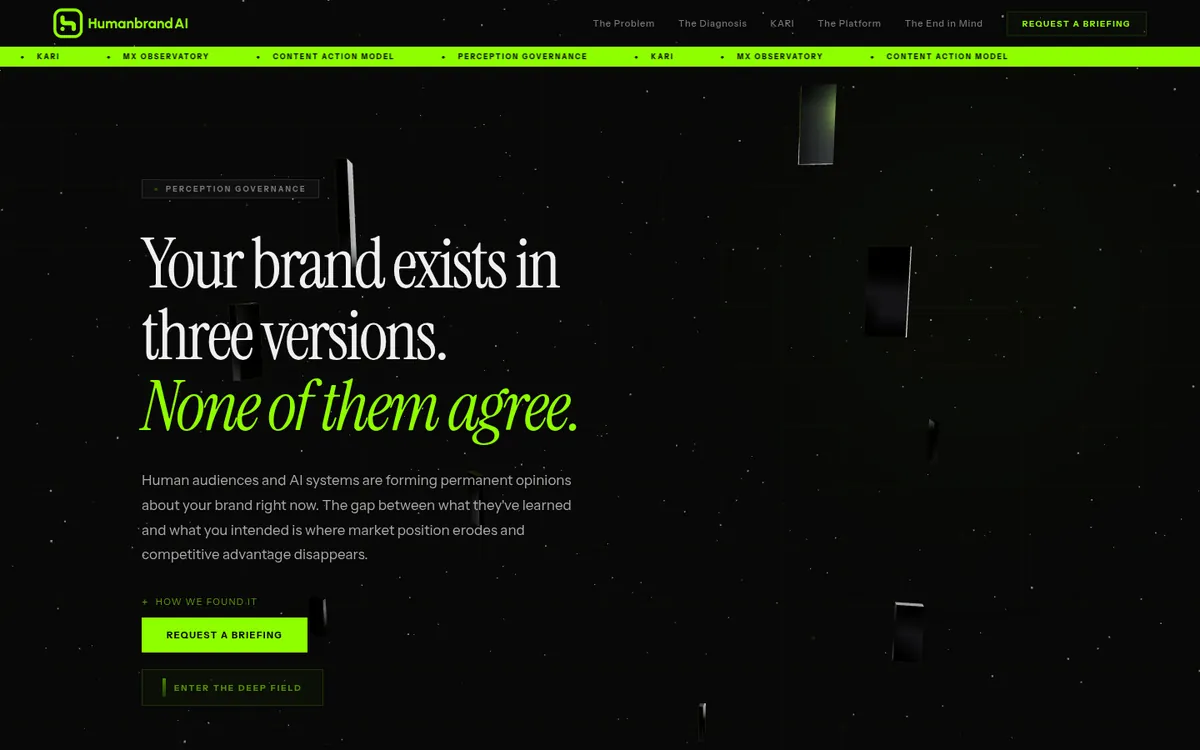
The front door
Your brand exists in three versions. None of them agree.
The humanbrand.ai home page, which leads brands into a briefing.
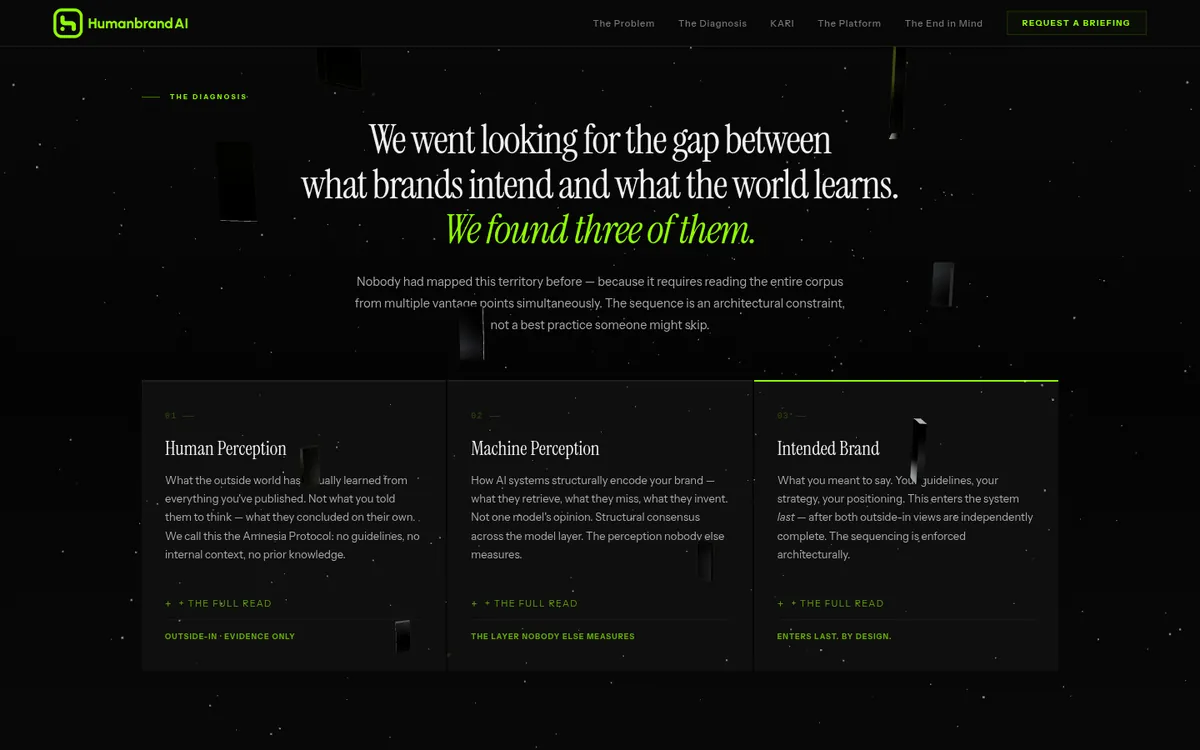
The Diagnosis
The gap between what brands intend and what the world learns
Humanbrand’s diagnosis view: Human Perception, Machine Perception and Intended Brand side by side.
Where it runs
Brand OS is model-independent and works where teams already are, inside Microsoft Teams and Copilot. Brands request a 30-minute briefing through humanbrand.ai, and our clients run each engagement with three human review gates.
Product facts on this page are taken from humanbrand.ai. We do not publish client usage figures without approval.
Building an AI product of your own?
Thirty minutes with a founder. You describe the problem, the deadline and what "done" looks like. We tell you whether we are the right team, and if we are not, we say so.
Prefer email? hello@jsklogics.com
- You speak with a founder, not a sales team.
- We sign an NDA before you share anything sensitive.
- You meet the people who will be accountable for the work.